Golden Pothos: The Trailing Vine That Refuses to Quit
By Arami Team · 9/21/2026
Meet Epipremnum aureum
If there's one houseplant that shows up in nearly every plant-lover's home, it's the golden pothos. Its trailing vines and glossy, heart-shaped leaves — splashed with streaks of green and golden-yellow — make it instantly recognizable, whether it's spilling out of a hanging basket or climbing a moss pole in the corner of a sunroom.
But golden pothos has another name, one that says a lot about why it's survived in cultivation for as long as it has: Devil's Ivy. It earned that nickname because it's almost impossible to kill — it stays green even when neglected, tucked into low light, or forgotten for weeks between waterings.
Where it comes from
Pothos is native to the tropical forests of French Polynesia, where it climbs tree trunks toward the canopy, its leaves growing larger and more deeply lobed the higher it reaches. In cultivation indoors, we mostly see its juvenile leaf form — smaller, heart-shaped, and perfectly happy trailing instead of climbing.
Caring for your pothos
- Light: Tolerates low light but the gold variegation gets brighter and more pronounced in bright, indirect light.
- Water: Let the top inch or two of soil dry out between waterings. Droopy leaves perk back up fast once watered.
- Soil: Any well-draining potting mix works — pothos isn't picky.
- Humidity: Adaptable to normal household humidity, no misting required.
The easiest plant to propagate
Snip a stem just below a node — the little brown bump where a leaf meets the vine — drop it in a jar of water, and roots usually appear within a week or two. It's how a single plant becomes a dozen jars on a windowsill, and why pothos cuttings are one of the most commonly swapped plants between friends.
Styling it well
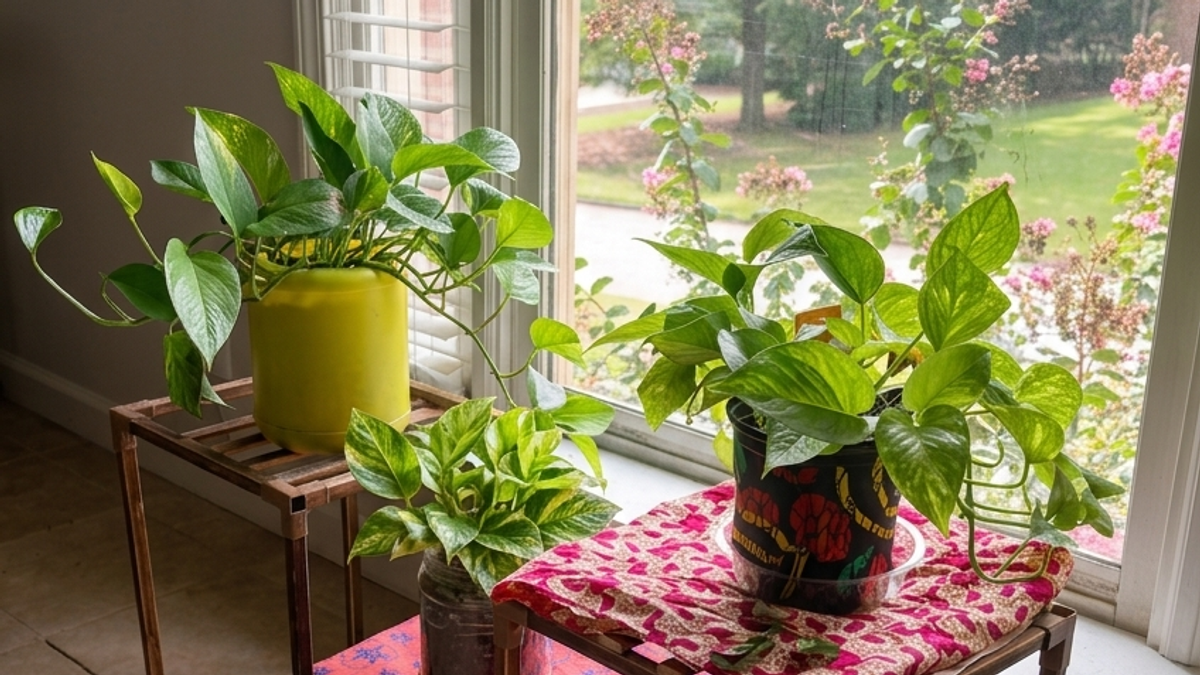
One of the simplest ways to make pothos feel intentional rather than incidental is to group a few pots at different heights near a bright window — a small jar cutting in front, a fuller plant in a bold ceramic pot behind it, vines left to trail over the edge of a tiered wooden stand. Layer in a patterned textile underneath and the whole corner starts to feel like a still life rather than just a plant shelf.
One note for households with pets: pothos contains calcium oxalate crystals and is toxic to cats and dogs if chewed, so keep trailing vines out of reach of curious mouths.